Every govtech vendor on the planet just discovered AI. You can tell because they all announced it at the same conference, in the same quarter, with the same press release:
"[Company Name] is excited to announce AI-powered capabilities across our platform."
Translation: they added a chatbot to the sidebar and gave it access to your help docs.
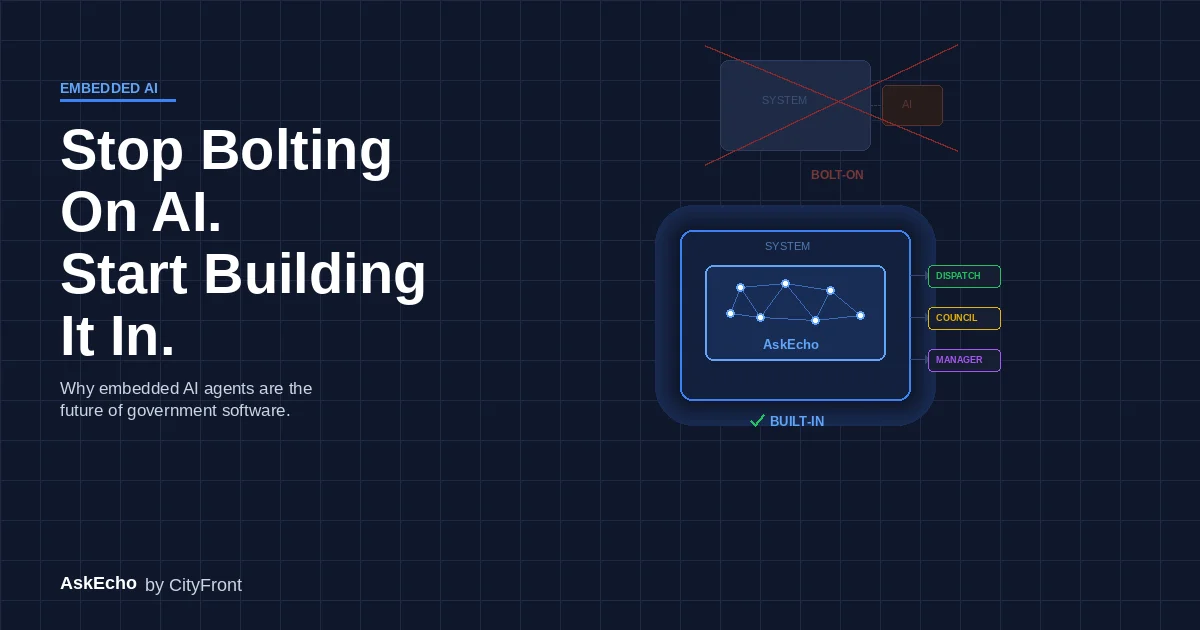
Congratulations. That's not AI inside your system. That's AI looking at your system through a window.
The Bolt-On Problem
Here's what's actually happening across govtech right now. Legacy vendors — the ones who've been selling the same architecture for a decade — are responding to the AI wave by doing what legacy vendors always do: bolting something onto the side of a product that was never designed for it.
They take a language model. They give it read access to some data. They put a chat window in the corner of the screen. And they call it "AI-powered."
What can it actually do? Answer questions. Maybe summarize something. Maybe surface a record if you ask nicely and use the right keywords.
What can't it do? Change a status. Assign a crew. Start a discussion with a coworker. Route a work order. Pull an SLA report. Submit anything on your behalf. Take any action that requires actual authority inside the system.
Your staff still clicks through five screens to change a ticket from "Reported" to "In Progress." The AI just watches.
That's not an agent. That's an audience.
What "Built In" Actually Means
When we say AskEcho is built into 311Command, we don't mean there's a chat window that can search your data. We mean the AI agent is part of the system the same way a staff member is — with a role, permissions, and the ability to take real actions.
A dispatcher says: "Change the status of CF-4471 to In Progress and assign it to the streets crew."
AskEcho does it. Status updated. Crew assigned. No dropdown menu. No five-screen navigation. No "save" button. Done.
A supervisor in the middle of a council meeting asks: "How many open requests are past SLA in the Public Works department?"
AskEcho doesn't send them to a dashboard. It gives them the answer right there. With context — why they're behind, who's assigned, what's been tried.
A city manager asks: "What did we spend on street maintenance in District 3 this quarter?"
AskEcho pulls the real cost data — equipment, manpower, materials — from work orders that have been tracking actual costs throughout the quarter. Not a budget estimate from three years ago. The real number.
That's not a search bar with personality. That's a domain expert that does real work inside your operational system.
"But What About Security?"
This is the question every CIO asks first, and they're right to. Giving an AI agent the ability to take actions inside your system isn't something you do casually. This is where the bolt-on approach doesn't just underwhelm — it fails.
A bolt-on AI doesn't understand your permission model. It either has access to everything (bad) or access to nothing useful (pointless). It doesn't know that a council member should be able to see work orders in their district but shouldn't be able to close them. It doesn't know that a field worker can update status on their assignments but can't reassign someone else's. It doesn't know that a dispatcher can route work but can't approve costs.
An embedded AI agent knows all of this. Because it inherits the role.
The agent inherits the role. That's the sentence that matters. In 311Command, AskEcho doesn't have its own permission set. It has your permission set. When a council member asks AskEcho to close a work order, AskEcho says no — because council members don't have that authority in your organization, and neither does their AI.
When a dispatcher asks AskEcho to reassign a work order, it does it — because dispatchers have that authority.
Same AI. Same system. Different permissions. Because the agent operates within the same role-based governance your organization already runs on.
Try getting that from a sidebar chatbot.
Every Action on the Record
Here's something most AI vendors don't want to talk about: what happens when someone asks the AI to do something it shouldn't?
In a bolt-on model, the answer is usually "nothing" — because the AI can't do anything anyway. But the question wasn't asked on any official record. The request happened in a chat window that may or may not be logged, may or may not be exportable, and definitely isn't going to show up in a FOIA response.
In 311Command, every interaction with AskEcho is on the official record. Who asked. What they asked for. What AskEcho did. What AskEcho refused to do. The full trail — logged, searchable, exportable.
That's not just a nice-to-have. That's FOIA compliance by default.
Think about what city staff does right now when they need to coordinate on a work order. They text each other. They send emails. They have side conversations in apps that disappear when someone leaves the department. None of that is on the record. All of it creates liability.
When the AI agent lives inside the system, the conversations happen where the data lives. Everything is attributed. Everything is auditable. Your city attorney sleeps better.
Doing More With Less — For Real This Time
Let's talk about what this actually means for a city that's running 2,000 work orders a month with a team that hasn't grown in five years.
Your dispatcher manages a queue of 50 open requests. With a traditional system, every action requires navigation: open the record, click the status dropdown, select the new status, save, go back to the queue, open the next record, assign the crew, save, go back. Repeat. All day.
With an embedded agent, the dispatcher says: "Assign the water main break on Elm Street to utility crew 3, priority high, and add a comment that residents have been notified."
One sentence. Three actions. Done. Back to managing the queue.
That's not a 10% efficiency gain. That's a fundamentally different way of working. The agent handles the clicking, the navigating, the form-filling — the mechanical work that eats up hours every day. Your staff focuses on judgment, coordination, and the complex cases that actually need a human brain.
A supervisor who used to spend two hours pulling a weekly report now asks AskEcho for it in a sentence. A city manager who used to schedule a meeting to get a department update gets it in 30 seconds. A field crew lead who used to call dispatch to update a status just tells AskEcho.
This isn't replacing staff. This is giving your staff an expert assistant that handles the mundane work so they can focus on the work that matters.
Why This Is a Solution — Not a Feature
Here's the distinction that separates what we're doing at CityFront from what most vendors are announcing.
When a vendor bolts AI onto their existing product, it's a feature. A nice addition. A checkbox on a comparison spreadsheet. If it goes away tomorrow, the product still works exactly the same. The AI was decoration.
When the AI agent is built into the solution — when it understands the domain, respects the roles, takes real actions, and operates on the same data as your team — it's not a feature. It's the architecture. It's how the system works.
311Command isn't a work order system with AI added on top. It's a work order system where AI is part of how your team operates the system. Remove the agent, and the experience is fundamentally different.
That's what makes this a solution, not a feature list. The AI isn't answering questions about your operations. It's participating in your operations — within your rules, under your governance, on your official record.
The Test Is Simple
Next time a vendor tells you their product is "AI-powered," ask three questions:
1. Can your AI take actions inside the system — change a status, assign a resource, create a record — or just answer questions?
If it can only answer questions, it's a search bar.
2. Does your AI respect my existing role-based permissions, or does it have its own access model?
If it has separate permissions from your staff, you've just created a governance gap.
3. Is every AI interaction logged on the official record and exportable for a FOIA request?
If the answer is "we're working on that," your city attorney should be working on their résumé.
A bolt-on AI fails all three. An embedded agent passes all three. And your staff can tell the difference in about five minutes.
The CityFront Model
This is how every CityFront solution works. AskEcho doesn't sit on top of our products. It lives inside them — trained as the domain expert for that system.
In 311Command, AskEcho is your AI Director of Public Works. It knows workflows, SLAs, crew routing, department coordination, escalation protocols, council reporting. Not because it searched the internet. Because we trained it for this specific job, operating only on your city's data, with your city's permissions.
That's not "AI-powered." That's AI-native. There's a difference. And your staff will notice it the first time they ask the system to do something — and it actually does it.
Related reading: Chatbots Are So 2015 | What Is an AI Service Delivery Platform?
Want to see an embedded AI agent in action? Book a 30-minute live demo of 311Command. Watch AskEcho change statuses, assign crews, pull reports, and refuse actions it shouldn't take — all inside the system, all on the record. Bring your IT team. Bring your toughest questions. This is the part where the vendor usually shows slides. We show the product working.