Let's be honest. If your city's "AI strategy" is a chatbot that answers FAQs and then tells residents to call the office anyway, you don't have an AI strategy. You have a fancy search bar with a personality.
Chatbots are so 2015.
We don't say that to be snarky. Okay, maybe a little. But here's the point: the chatbot era taught local government one real lesson — residents will use self-service tools if you give them something that actually works. The problem is, most chatbots don't actually work. They answer the question and then abandon you. "For further assistance, please call 311 during business hours."
Thanks. Super helpful. At 11pm on a Tuesday.
The Difference Between Answering and Doing
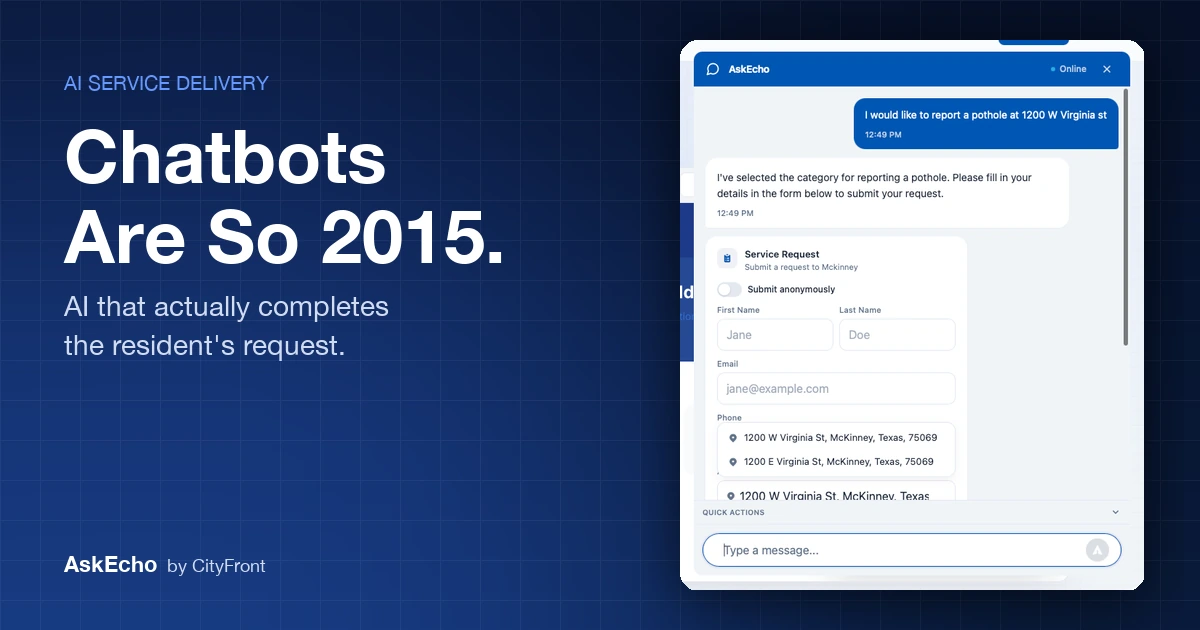
Here's a test. Ask your current chatbot to submit a pothole report.
Not link to a form. Not redirect to a portal. Actually submit it — with the location, the description, and a confirmation number back to the resident.
If it can't do that, it's not an AI service delivery tool. It's a FAQ bot in a trench coat pretending to be one.
An AI service delivery worker — and yes, we're using that phrase on purpose — does the whole job. A resident says "there's a pothole on Oak Street near the elementary school" and the system captures the location, creates the service request in your system of record, routes it to the right department, and sends the resident a confirmation. One conversation. Done. No phone call. No form. No "please call back during business hours."
That's not a small difference. That's a completely different category of technology.
Why This Matters More Than You Think
City and county managers: think about how many inbound contacts your 311 center, front desk, or general email handles in a day. Now think about what percentage of those are the same 20 questions — trash pickup schedules, permit status, park reservations, payment due dates.
Your staff is spending 80% of their time on requests that could be completed automatically, in one conversation, in any of 26 languages, at 2am on a Saturday. Instead, they're answering the same phone call for the 300th time this month while the complex cases — the ones that actually need human judgment — pile up behind them.
A chatbot doesn't fix that. It just moves the FAQ to a different screen. The resident still has to call for anything real.
An AI service delivery worker fixes it by completing the transaction. The resident gets what they need. The staff focuses on what matters. The city manager stops getting complaints about hold times.
"But We Already Tried a Chatbot and It Didn't Work"
We hear this a lot. And every time, the story is the same: the city deployed a chatbot, residents used it a few times, realized it couldn't actually do anything, and went back to calling. The chatbot sits on the website like a decorative widget nobody trusts.
That's not a failure of AI. That's a failure of architecture. Chatbots are built to answer. AI service delivery platforms are built to act — directly in your systems of record. Cityworks, Dynamics, Tyler, Accela, CivicPlus — the systems your departments already run on. The AI doesn't replace them. It becomes the front door to them.
Different architecture. Different outcome.
What "Day One" Actually Looks Like
Here's what kills most AI projects in government: the 18-month implementation timeline, the $500K budget, and the IT team that has to babysit a fragile integration.
What if Day One was actually day one? A JavaScript snippet on your website. AskEcho live on your public-facing content. Residents getting real answers (not hallucinated ones — only from your approved data sources) in 26 languages. No IT project. No procurement drama.
That's Stage 1. You prove it works. You get the data. Then you grow — add integrations, add channels, add departments. At your pace, governed by your team, with someone else building and maintaining the integrations so your IT department doesn't inherit another thing to babysit.
That's not a sales pitch. That's how CityFront actually deploys. From DFW to Illinois, that's the model.
The Question to Ask Your Current Vendor
Next time your chatbot vendor shows up for a renewal conversation, ask them one question:
"Can your system complete a full 311 service request, process a payment, and route to our system of record — in one resident conversation — without a phone call?"
If the answer is no, you're paying for 2015 technology in 2026.
And your residents know it.
Related reading: What Is an AI Service Delivery Platform? | Day One Should Actually Be Day One
Ready to see the difference? Book a 15-minute live demo and watch AskEcho handle a real resident request — start to finish, in any language, directly in your systems of record. No slides. No promises. Just the product doing the work.